Apartment Amenities Worth Paying For (and 4 You Should Skip)
Which apartment amenities justify higher rent and which are just window dressing. A real breakdown built from Packard Row in Ann Arbor.
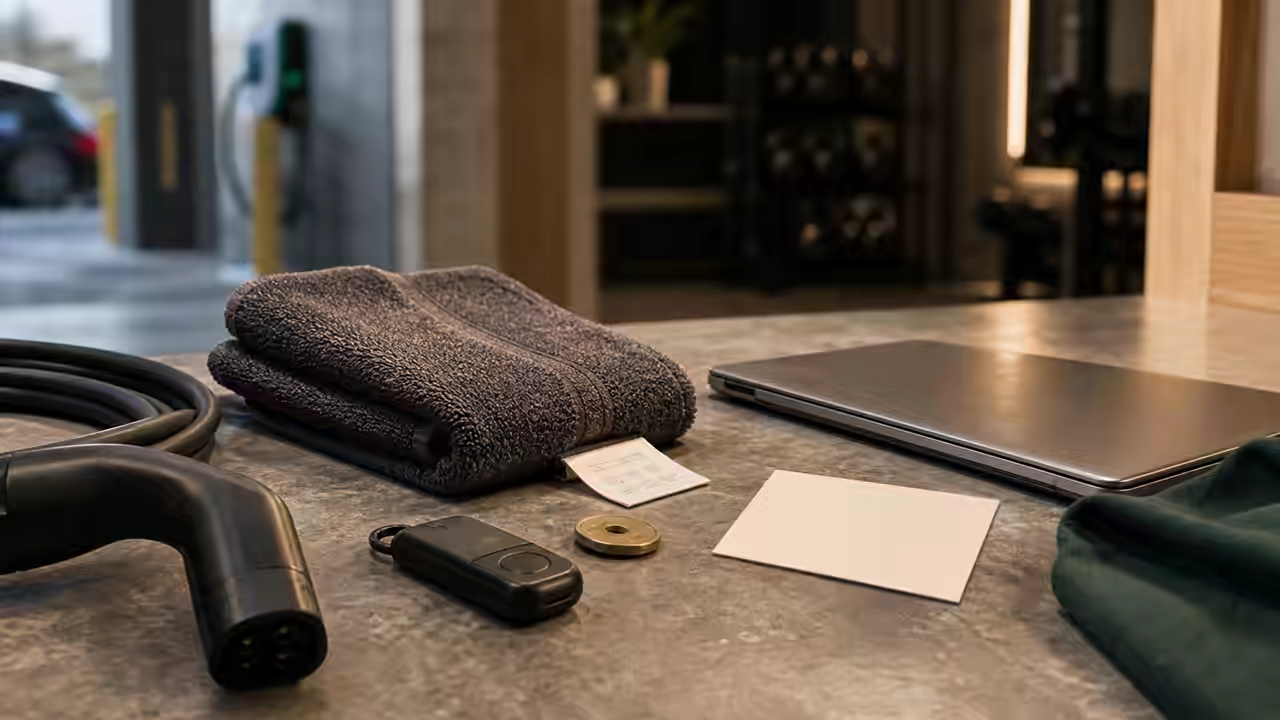
The leasing agent will read you a list. Fitness center, clubhouse, EV chargers, rooftop solar, bike racks, conference room, pet spa. Twelve items. You'll touch maybe six.
A few quietly change your week. The rest is rent you'll never see back.
Packard Row opened on Packard Street in Ann Arbor in May 2025. New Class A building, full spread: 24-hour fitness center, controlled access, conference room, EV chargers, rooftop solar, clubhouse, elevators, off-street parking, bike racks, in-unit washer/dryer, balconies on some units. Rents run $2,250 to $3,015 a month, which is steep for Bryant Pattengill East. Which of those amenities actually earn the bump?
The test
Three questions per amenity. Does it replace something you'd pay for anyway? Does it save you real time every week? Does it remove a daily annoyance? Yes to any one and it carries weight. Yes to none and it's brochure padding.
24-hour fitness center
The best amenity in any building, full stop.
A mid-tier gym membership in Ann Arbor (LA Fitness on Washtenaw, the Y on West Washington) runs $35 to $60 a month. Per person. Couples double it. Roommates splitting a two-bedroom, same. Somewhere between $420 and $1,440 a year you keep.
The money is the boring half of the argument.
The real win is that the gym is downstairs. A 12-minute drive away kills your week three times out of five. Twelve seconds in the elevator doesn't. You go at 6 a.m. before the building wakes up. You go at 9 p.m. when the idea of putting on a coat ends most plans. You go in January when the car won't start. Packard Row's fitness center runs 24 hours, weight bench, dumbbells, cardio. It isn't a Gold's. For 80% of workouts it doesn't need to be.
Verdict: Worth it.
Controlled building access
Locked front door. Key fob. No one inside who doesn't live there or got buzzed in.
Costs the owner almost nothing. A door, some fobs.
Ann Arbor isn't dangerous, but packages still walk off porches, and people still tailgate strangers into lobbies. I had someone knock on my door at 11 p.m. in a building that called itself secure. Controlled access closes the easiest hole, which is random foot traffic. If you live alone, or if you've ever had someone follow you into a vestibule, it stops being a checkbox.
Verdict: Worth it.
In-unit washer and dryer
Every renter already knows. The math keeps tilting harder.
Coin-op runs $2 to $4 a wash, the same again to dry. Three loads a week is $12 to $24, or $624 to $1,248 a year. Per person. Plus the part where you haul a basket two floors down at 10 p.m., wait for a free machine, and come back to your wet jeans piled on a counter because the next person got impatient.
Every unit at Packard Row has its own washer and dryer. You don't go back to coin-op once you've left it.
Verdict: Worth it.
Off-street parking
Street parking on Packard is tight. Snow emergencies mean move the car or it gets towed. Michigan home games turn every curb within a mile into a slow-motion knife fight.
A dedicated lot spot means you always park. Your car isn't on a public street at 2 a.m. No tickets, no tow truck, no scraping ice in traffic. You use parking every single day. If you own a car, it isn't optional. Pretending otherwise is how people end up moving twice in a year.
Verdict: Worth it.
EV charging stations
This one splits by what you drive.
If you have an EV or a plug-in hybrid, on-site charging is huge. Public chargers in Ann Arbor exist (a handful of ChargePoint at Briarwood, a couple around campus, some at Meijer), but they're sparse and half the time one is broken. Nothing beats the cord in your own lot. Charging at home overnight runs about a third per kilowatt-hour of what DC fast charging costs.
Packard Row has chargers on site. For anyone driving electric, it's probably a decision-maker. For gas drivers, it does nothing.
It does say something about the building, though. Putting in chargers in 2024-25 costs real money, and most properties from five years ago didn't bother. That kind of spend usually shows up in how the rest of the building gets maintained.
Verdict: Worth it if you drive electric. Skip if you don't.
Conference room / workspace
A single room off the clubhouse. Table, chairs, quiet enough that your roommate isn't a face in your Zoom frame.
Tens of millions of Americans work hybrid or remote now. If you're one of them, a building workspace solves a specific, recurring problem. 2 p.m. presentation, the light in your apartment is bad. Or your roommate's also on a call. Or the coffee shop Wi-Fi drops three times in an hour. The conference room sits there for the two or three times a month you actually need it.
It also tells you who the building expects to rent to. Between Google, Thomson Reuters, ProQuest, and U-M, that bet makes sense. Anyone moving to Ann Arbor for work at one of those employers tends to need exactly this room.
Verdict: Worth it. Low usage and low value aren't the same thing. When you need it, nothing else covers.
Skip these
Sound great on the tour. Used twice in month one. Forgotten by month six. Still in your rent.
The clubhouse
Every Class A building has one. Couches, maybe a fireplace, a TV, a coffee machine. The lease packet will call it a "community gathering space."
Residents use it roughly zero times after the first month. They have their own couch. Friends come to their apartment, not the lobby. The clubhouse is good for the property manager's Instagram, and useful once a year when you host a birthday for 20 people who can't fit in your unit.
Packard Row's is genuinely well done. Marble fireplace, dining area, real seating. The photos pop. If you host a study group or a dinner that outgrows your kitchen, it's a decent backup. Most months it's empty.
Verdict: Skip. Nice. Don't pay extra rent over it.
Rooftop solar panels
Part of the sustainability angle here, alongside native-tree floor plan names, EV chargers, energy-efficient appliances, smoke-free. The brand leans on it.
Solar lowers grid draw on the building. That cuts the owner's operating costs. Good for the planet, too.
It does not cut your electric bill in any meaningful way. In almost every multifamily setup the panels offset common-area power (hallway lights, gym, lobby HVAC), not your unit meter. You pay roughly what you'd pay in a non-solar building.
Solar is a values amenity, not a financial one. If living somewhere environmentally aligned matters to you, fine. If you're running a spreadsheet, treat it as a rounding error.
Verdict: Skip, financially. Worth weighting if sustainability is a personal priority.
Bike racks
Sounds practical. Is, for some people.
A bike rack is a metal bar bolted to concrete. You can buy a wall-mount for your apartment for about $40. The building having one isn't really a feature. It's table stakes, the same category as a mailbox. If the leasing agent leads with the bike racks, the list is padded.
Verdict: Skip.
Elevators
In a three- or four-story building, an elevator is genuinely useful. Move-in day, groceries, the week you twist your ankle.
It's also one of the biggest line items in mid-rise construction, and that money shows up in your rent. If you're on the second floor taking the stairs every day, you're paying for something you barely touch.
In a taller building, five stories and up, elevators stop being a question. At Packard Row's scale, they're convenient. They shouldn't drive your unit pick.
Verdict: Neutral.
How Packard Row stacks up
Run the framework, the building mostly nails it.
24-hour fitness. Controlled access. Washer/dryer in every unit. Off-street parking. EV charging. Conference room. You'll use those things. They reshape the week. The same logic applies whether you take the 1-bedroom or 2-bedroom path, because every unit gets the same amenity set.
The clubhouse exists. The solar exists. The bike racks exist. They make the brochure longer. They don't hurt anyone. They shouldn't tip your lease decision and they aren't worth a rent bump.
What I actually like here is the restraint. No golf simulator. No yoga studio that's really a storage closet. No rooftop pool open three months and jammed every weekend of those three. The list is short and the items work. Usually a sign a building is managed well in other ways too.
Evaluating any building
Skip the brochure. Walk the building at 7 p.m. on a Tuesday. Is the gym in use or empty? Is the conference room locked or has someone parked a laptop in it? Is the clubhouse dark?
Then run three questions on every line item.
Does this replace something I'm paying for now? Gym, public charging, coin-op.
Does it save me time every week? Parking, laundry, the building gym.
Does it kill a daily stressor? Controlled access, a guaranteed parking spot.
All three: non-negotiable. Two: valuable. One or zero: window dressing.
The buildings that pass this test tend to get the rest right too. When you compare the overall rent picture in Ann Arbor for 2026, pick the one with the shorter list where everything works.
Related guides
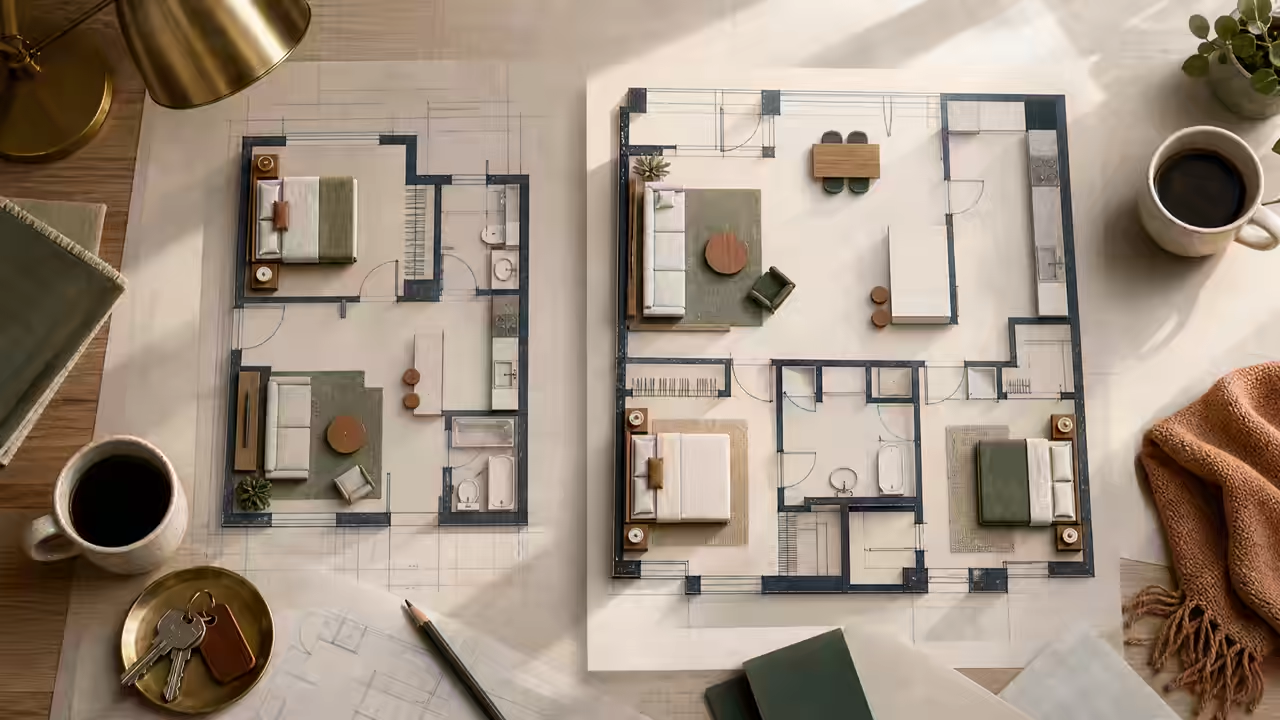
1-bedroom vs. 2-bedroom at Packard Row: which fits?
Six floor plans, two layouts, $250 to $800 between them. The real math on a 1BR versus 2BR at Packard Row, including the per-person split with a roommate.
How much does it cost to rent in Ann Arbor in 2026?
Ann Arbor rent runs $1,200 to $3,000+ depending on size, building age, and neighborhood. Here's what renters actually pay in 2026, by unit type and building class.

Living on Packard Street: Bryant-Pattengill East, Ann Arbor
A quiet stretch of southeast Ann Arbor between Packard and Platt. Close to U-M, County Farm Park, and a real café — here's what actually living here looks like.